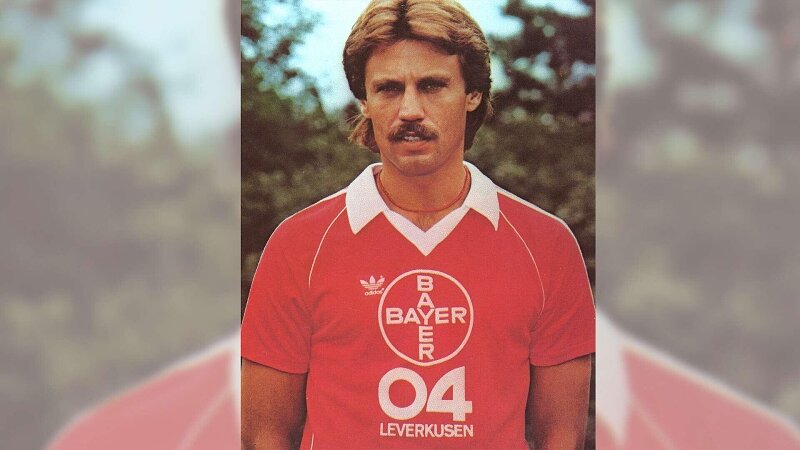
In 1986/ 87 he finished runner-up in the league with his team and with 24 goals the top scorer in the Ekstraklasa, Poland's top-flight. In 1986 he played his first of 20 international matches for Poland scoring ten goals along the way. But he mainly played for the Poland Olympic team and in 1988 he used the opportunity of an international trip to Denmark to defect. He fled to the Federal Republic of Germany where he wanted to carry on playing in the Bundesliga. At that time, a Polish international player could only move abroad at the age of 28 otherwise the Polish FA PZPN would refuse them permission to play.
Bayer 04 Leverkusen stepped in to help out the very pacy striker and agreed a transfer fee of two million Deutschmarks with the Polish FA and Pogon Stettin. In addition, Bayer AG delivered medicines to the People's Republic of Poland to a value that by far exceeded the total of the transfer fee.
Marek became a crowd favourite under coach Rinus Michels. His sprints down the wing were only topped by his sprints after scoring in the direction of the fans including jumping on the fence, which he picked up from the Brazilian Tita. A little anecdote: After making it 3-1 against Borussia Mönchengladbach, he again sprinted in the direction of the fence, jumped on it only to discover that he was in front of the Borussia fans. He jumped back off the fence pretty quickly and celebrated with his teammates.
In his four years under the Bayer Cross, 'zigzag Lesniak', as he was called by the Bayer 04 fans for his quick dribbles, made 132 appearances for the Werkself and he scored 23 goals. When general manager Reiner Calmund first brought in the East Germany international Andreas Thom and six months later centre forward Ulf Kirsten to Leverkusen, Marek’s chances of a regular start diminished and he increasingly found himself on the bench. So he moved on in the Bundesliga, first to Wattenscheid 09 then to 1860 Munich and KFC Uerdingen. A year in Switzerland playing for Xamax Neuchatel was not a success. So, he signed for Fortuna Düsseldorf in the second division at the age of 33. He carried on playing up to the age of 40 for Preußen Münster and SSVg Velbert. At his last club, he was player coach and then in the following years in the dugout as coach. In addition to SSVg Velbert he also coached the teams at Wattenscheid 09 and TuSpo Richrath. Today he is the coach of the U19 team at FV Wiehl.
Dear Marek, I wish you many happy returns on your 60th birthday. Stay fit and healthy and look after yourself!