promotion party with vips
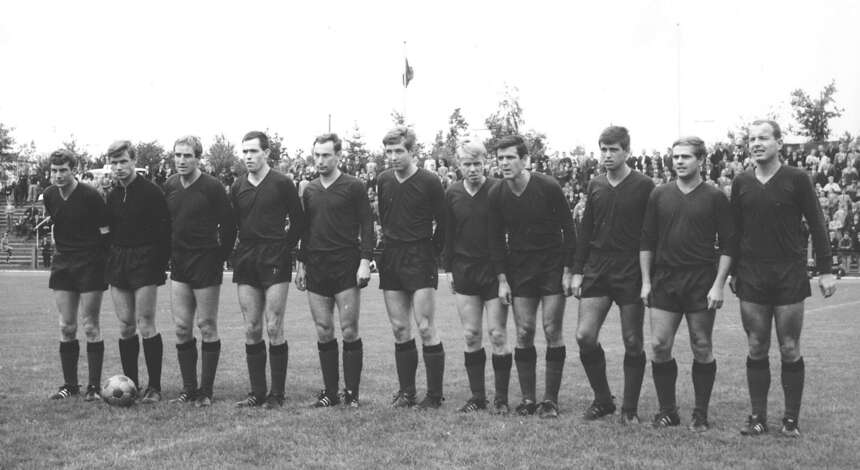
After a weekend with two friendly matches in Westphalia against VfB Bielefeld (2-0) and in Ahlen (0-0), the members are looking forward to the big promotion celebration at the Bayer Kasino. The team will be honoured on Saturday, 19 May. Unfortunately, not all Bayer 04 members will be able to attend the party, so lots are drawn.
The team is honoured right at the beginning. The entertainment programme then begins. This is led by the actress Charlott Daudert, the actress and singer Lonny Kellner, who marrieds the well-known television presenter Peter Frankenfeld two years later, and the actor Hans Müller-Westernhagen, the father of Marius Müller-Westernhagen, who was born in 1948. Late in the evening, the Cologne Dance and Entertainment Orchestra, conducted by Adalbert Luczkowski, performs in the main hall. If the main hall is too full, you can move to the sounds of Albert Vossen and his rhythm section in the side hall. For the aficionados, Bayer AG provide buses for the journey to the main railway station in Cologne or to the railway station in Opladen. At the end, according to press spokesman Heinz Nelles, the party can be described as "all in all a successful celebration that will remain a pleasant memory for the participants for a long time to come".
At the end of May, the Werkself face Viktoria Aschaffenburg, who have been promoted to the Oberliga Süd 1. In their midfield, former international Ernst Lehner pulls the strings, still proving his class at almost 40 years of age. The approximately 3,000 spectators, some of whom had to take the entrance fee out of their own budgets at the end of the month, were not disappointed. The friendly match was of a high standard from the outset and featured scenes reminiscent of a championship match. Emil Becks puts Bayer 04 ahead, but the two Aschaffenburg wingers turn the game around before half-time to give Viktoria the lead. In the second half, the Werkself pinned their opponents back in their own half for stretches, but the equaliser would not come despite numerous chances to score. It was not until three minutes before the end that Emil Becks was once again able to equalise.
But that's not the end of the season for the Bayer 04 team. There are still some friendly matches to come in June and a big newspaper article in the RheinEcho, which will introduce our team to readers in more detail. But I'll come back to that in June.