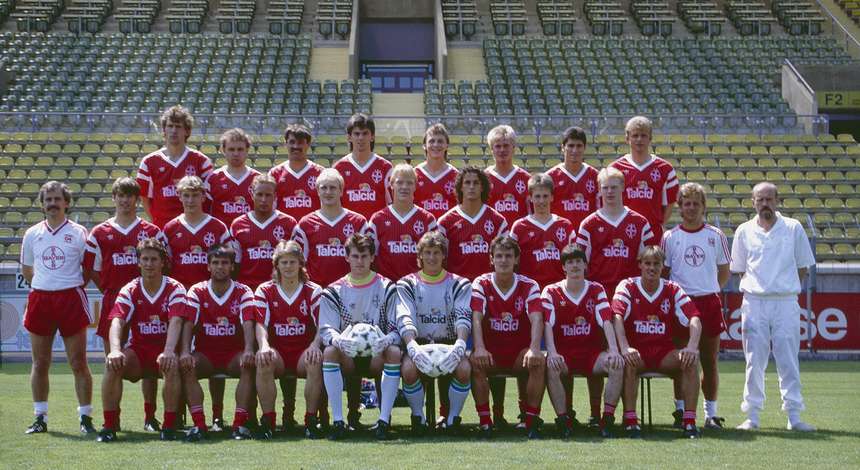
There was a good mix of training, matches and time off in San Francisco, Los Angeles und San Diego. And one or two players used the opportunity to spend their summer holidays in the Californian sun afterwards. During the three-week stay, the idea was born of holding the annual winter training camp, which in the 80s mostly took place on the Canary Islands, in Orlando in January 1991.
The second Gulf War and the American attacks on Baghdad unsettled members of the team and it came to a vote: �The majority the players voted to stay in Germany.
freezing in Florida
With temperatures of minus ten degrees, they trained on Timmendorfer Strand on a frozen surface. But a year later in January 1992 came the change: Sunny and warm Florida awaited. That was certainly what the kit man Harald Wohner thought and he only packed shorts and short sleeve shirts. In the first training session, there was a shock for the team with the temperature at four degrees so it was another case of freezing training. Our good friend Harry then raided the local sports shops. The players were then able to train in colourful but suitable kit.
But the short sleeve shirts were used in matches. And in the words of our physio Dieter Trzolek, "They're supposed to run and not stand still!" The weather in Florida improved and it turned out to be a successful training camp. The Werkself came out on top in games against the USA Olympic team (3-1) and a local amateur side (14-0). There was also a 3-1 victory against Orlando Lions, an American top-flight side.
finale in Los Angeles
To end the training camp, Bayer 04 flew to Los Angeles for the final game against the Mexican champions UNA Mexico. There was a clash under real competitive conditions in front of 10,000 passionate Mexican fans. The first real test in 1992 ended with a 1-1 draw.
Unfortunately the training camp did not bring the desired success at the end of the season as Bayer 04 failed to qualify for the UEFA Cup and lost out in the DFB Cup semi-finals on penalties against Borussia Mönchengladbach. But it was back to Orlando a year later. And what happened at the end of the season in 1993 should be familiar to every Bayer 04 fan.