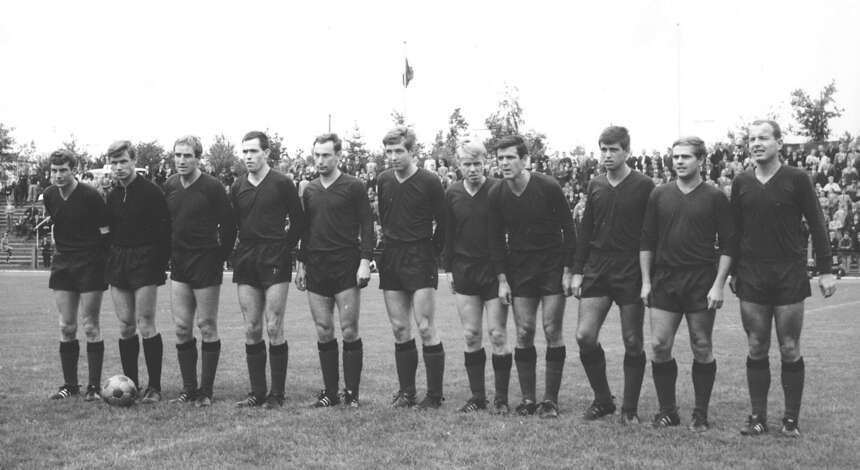
In the first half, Bayer 04 are playing into a low sun and very strong wind. Leverkusen are unable to make the most of dominating possession. The two sides going goalless at half-time.
After the restart, the hosts are camped in the opposition half. Dr Klaus Heydenreich, with an assist from Hans-Otto Peters, gives Bayer 04 the deserved lead at 1-0 on 50 minutes with the help of the wind. A minute later, with a counter-attack from Herten, goalkeeper Friedhelm Renno makes a save with a full-length dive. He collides with a Herten player and both fall to the ground. But the Bayer keeper does not get up again. He has broken his ankle. Renno is carried off on a stretcher and defender Werner Biskup pulls on the keeper’s shirt.
With eleven against ten, the visitors sense a chance and pepper the stand-in goalkeeper. But he not only surprises the spectators. Diving, catching and punching he keeps a clean sheet. And the ten Leverkusen players not only resist but also go on the front foot. Heydenreich increases the lead with two more goals on 65 and 80 minutes to make it 3-0 and clock up a hat-trick. The fourth goal on 85 minutes is scored by the young Hans-Joachim Wöhler who made the step up to the first team from the youth ranks in the summer. Werner Biskup did have to pick the ball out of the back of the net in the end. But that doesn't matter as all the Bayer 04 fans go home happy after the 4-1 win. New Year's Eve 1963 can come.
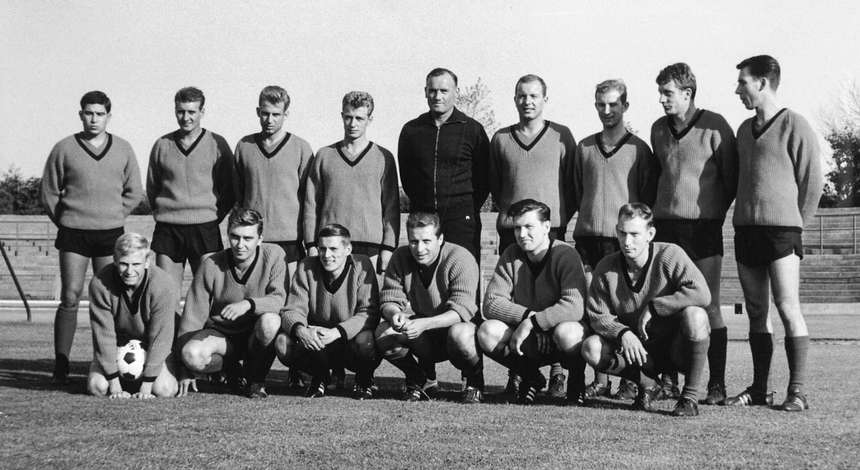
Minas Hantzidis was born on 4 July 1966 in Kettwig, near Essen, and he grew up in Germany. He developed a passion for football at a young age and, whilst still a youth player, moved from Wuppertaler SV to Bayer 04. The attacking and goal-scoring midfielder then made a name for himself in his first senior season at Bayer 04. In the reserve team, he scored goal after goal in the first half of the season, soon began training with the first team and was brought on as a substitute for the first time by manager Erich Ribbeck on 22 November 1985 in a home match against Bayern Munich.
Show more
Sascha was born on 3 July 1986 in Leverkusen. He is the son of former Bundesliga 2 player Manfred Dum, who mainly scored goals for Union Solingen but also played for FC Saarbrücken, SC Freiburg and Wuppertaler SV. Sascha started playing for the youth teams at HSV Langenfeld at an early age. There, he caught the eye of scouts from Bayer 04 and joined the club at a young age. Following a growth spurt in the U15 team, which forced him to take a nine-month break, the left-footed player finally had the ideal conditions to establish himself in the Bayer 04 youth ranks. Even as an U17 player, he made the leap into the U19 team. Blessed with immense pace, Sascha primarily played in attacking midfield. Not the most technically gifted, but possessing a powerful shot, he found himself training with the first team in the summer of 2005 alongside Gonzalo Castro, while he was still a U19 player.
Show more
The Werkself could not have hoped for a better start to the Bundesliga 2 North season in 1976/77. At the end of a week-long training camp in Quickborn, Schleswig-Holstein, coach Willibert Kremer’s side secured two convincing victories over BSC Brunsbüttel (5–0) and TuS Holstein Quickborn (6–0). Following this flying start, Bayer 04 faced a considerably tougher challenge on 23 July 1976 at 19:30 CEST at the Ulrich Haberland Stadium against Bundesliga side Karlsruher SC.
Show more
On 27 June 2001, new head coach Klaus Toppmöller and his assistant Peter Hermann led the Werkself out of the changing rooms for their first training session. Joining them as they stepped onto the pitch at training ground 1 were the four new signings: Hans Jörg Butt, Yildiray Bastürk (with special permission from VfL Bochum, as Bayer 04 and VfL had not yet agreed on a transfer fee), Zoltan Sebescen and Michael Zepek, the record holder for appearances for the youth national team.
Show more
Hans Sarpei was born on 28 June 1976 in Tema, Ghana, and came to Germany with his parents at the age of three, where he grew up in Cologne. Even before he was born, his mother and father worked in Hamburg in the import-export sector. There they met an older man who introduced them to German culture and supported them. Out of gratitude, Hans was later given his first name, although this man died before he was born. Hans comes from a sporting family; his older brother Edward and his nephews Hans Nunoo Sarpei and Kingsley Sarpei were or are also professional footballers.
Show more