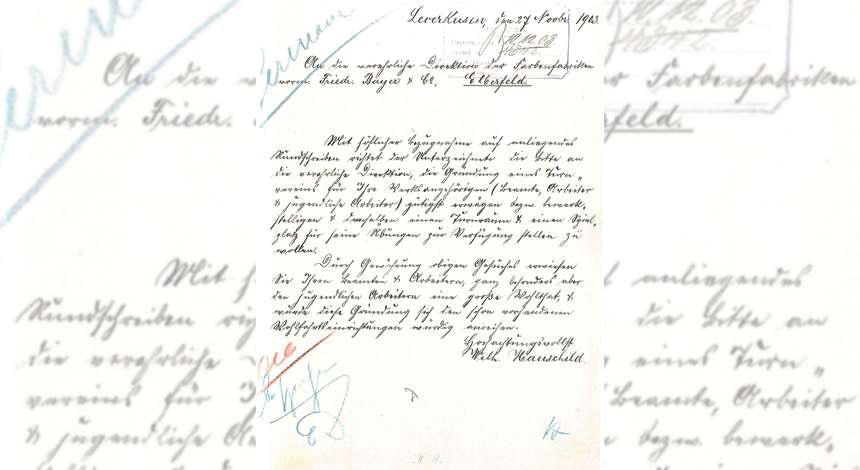
Just a few lines were written exactly 120 years ago today on 27 November 1903. A letter with two paragraphs, and attached circular and a list with 170 signatures. Documents of historic importance for our club. They were the basis of its foundation.
The letter in original text:
Leverkusen, 27 November 1903
To the venerable management of the paint factories of Friedr. Bayer & Co. Elberfeld.
With polite reference to the attached circular, the undersigned submit the request to the venerable management to kindly consider the foundation of a gymnastics club for your employees (office staff, workers and young workers) or make available a gymnasium and playing field for exercises. Through the granting of the above request you would provide a great benefit to your office staff and workers and this foundation would prove to be a worthy addition to the existing welfare provisions.
Yours sincerely,
Wilh. Hauschild.
the signatories
The then 47-year-old signatory Wilhelm Hauschild was a gymnast at TG Elberfeld and for several years had been a gymnastics supervisor in the district of Wuppertal. And he was an employee of the open trading company founded in Wuppertal in 1863 named Friedr. Bayer & Co-, which later became the ‘Farbenfabriken’ and finally Bayer AG. Hauschild was one of the employees who moved from the Wupper to the Rhine when a second production site of Friedr. Bayer & Co. was established south of Wiesdorf in 1891. He and his colleagues wanted to take part in sport in their new home town. There were already several gymnastics clubs in the area. TV Schlebusch was founded in 1881, followed a year later by TV Opladen, which was later renamed TuS 82 Opladen. There were also clubs for gymnastics in Neukirchen (1886, back then without the prefix ‘Bergisch’), Bürrig (1887), Rheindorf (1892) and Hitdorf (1893). But they were a long way away for the employees of the paint factories in Wiesdorf. There was hardly any financial assistance and walking would have taken hours.
"our Leverkusen"
So Wilhelm Hauschild and his colleague August Kuhlmann, the then men's gymnastics supervisor at Sonnborner TV, wrote a circular in February 1903 “to the gentlemen works and office staff Leverkusen." The two stated: "There are few places in the German Fatherland where there are no gymnastics and sports grounds, including our Leverkusen that with its large number of officers and workers has a particular reason to seek the opportunity to create a balance for the activities due to the current allocation of work that are mostly very uniform and involve little physical movement. […] Those gentlemen, who have an interest in offering gymnastic and sports opportunities in Leverkusen, are now requested to indicate interest by signing and therefore being able to direct your request to the management of the Farbenfabriken to provide support in this matter." Over the course of the following weeks 170 signatories were collected including a number of engineers and other academics.
"Our Leverkusen," as it was called by Hauschild and Kuhlmann, was the site of the works south of the small farming and fishing village of Wiesdorf in 1903. The spot in the provinces was named after Carl Leverkus, who set up his ultramarine factory for the production of blue dyes in 1863. The town of Leverkusen was founded in 1930. The population of Wiesdorf trebled between 1891 and 1905, rising from 3,000 to 10,000 inhabitants, with around 4,000 working for the paint factories.
THE Kaiser's sore throat
The two letters from February and November where written in the style and tone of written communication and conventions of the time. It was the officialese of the German Empire. We are back in the year 1903: The headlines at the end of November were dominated by the health and emotional state of Kaiser Wilhelm II who was undergoing treatment due to a throat infection. The 'Opladener Zeitung – Messenger and Gazette to the Nieder-Wupper’ reported an "enthralling tragedy," currently happening in the New Palace in Potsdam. Wilhelm II, whose father Kaiser Friedrich III had died of throat cancer, was becoming "more and more subdued and sombre." It ended well as the last German Kaiser and King of Prussia died in 1941 at the age of 82 in exile in the Netherlands in Doorn.
Leipzig first champions of germany
In terms of sport: July 1903 saw the first cycle race in France with 60 participants – the first Tour de France. VfB Leipzig became the first champions of Germany at the end of May – with a 7-2 win in the final against the German Football Club Prague in Altona. The organisers of the championship, the German Football Association (DFB), had been founded three years earlier.
the management is pleased
At the end of November 1903, Wilhelm Hauschild and his colleagues hoped for a swift and positive decision on their request. They did not have to wait long for the response from the headquarters in Elberfeld. The management announced on 12 December 1903 "that they would be extremely happy if a gymnastics club would come about."Friedrich Bayer jr. and Carl Duisberg raised the prospect of the construction of a gymnastics hall. That was the starting shot the foundation of a unique club that would soon offer a sporting home for football players. The roots go back to 27 November 1903. Bayer 04 look forward to marking this anniversary next year.