Mr Schmitz, there are no games in the Bundesliga due to the coronavirus crisis. Does a break like that benefit the ground staff?
The sense and purpose of our work is maintaining the best possible playing surface – and that’s clearly working very well at the moment. But it’s anything but good against the background of the coronavirus crisis. Grass and football go hand in hand.
There are normally lots of games in the closing stages of a season. How has the daily work routine at Bismarckstraße and at Kurtekotten changed for you and your team in recent weeks?
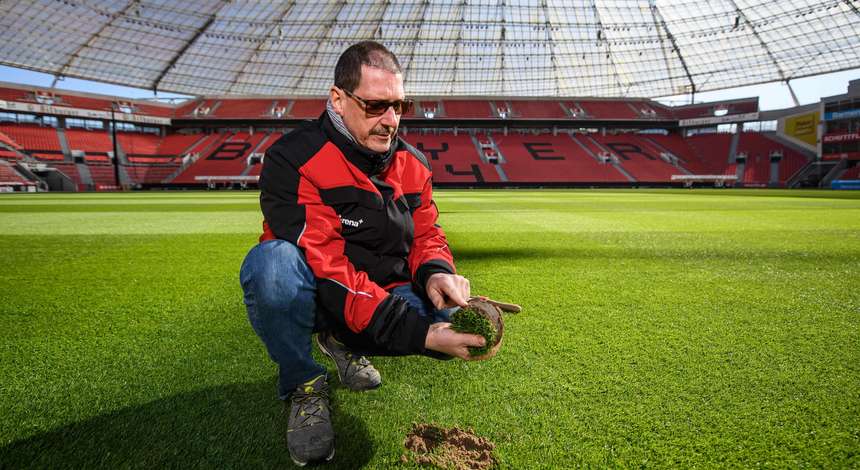
We’ve come out of a period of lots of games. The pitch is in very good condition again now. That’s why it was and and is about doing pre-emptive work. We’ve been able to use the break up to now to bring forward remedial measures, which normally happen in the summer. At the same time, the temperatures aren’t yet optimal so we have to support the processes with undersoil heating and lighting.

Last season, the Werkself played four games in twelve days at the BayArena between October and November. There could be a similarly busy schedule with the end of the season possible in early summer.
At the time we had a lot of rainfall and cold temperatures. We’re now expecting warmer and sunnier weather and growth will increase. If grass is fed with the right nutrients then it can grow two centimetres overnight and look completely different after two days. With the problem of worn areas like the goalmouth, we’ll have to replace them during a phase like this.
Head coach Peter Bosz never tires of emphasising how important a good pitch is for the way the Werkself play. What’s particularly important with your work on the pitch?
The demands on pitches is high throughout the league. We always aim to get worn areas green again as soon as possible. We work with a natural product that sometimes takes a bit of time. We use artificial light and heat to speed up the process. One challenge in our day-to-day work is the height of the grass is getting lower and lower. A couple of years ago it was mostly 28 millimetres and now it’s often 23 or 24 millimetres. That’s why we sowed 100 per cent meadow grass when he replaced the pitch in November. This type has very vigorous root growth. Finally, we sowed pasture grass because it recovers quicker.
And finally: Are you as busy in your own garden at home?
The circumstances are very different (he laughs). It’s a landscape lawn with daisies and clover. Everything that should be there.
Barely two weeks since beating St. Pauli in the DFB Pokal quarter-finals, Bayer 04 again welcome the Hamburg club to the BayArena for Matchday 22 in the Bundesliga this Saturday (kick-off: 15:30 CET). The visitors received a welcome confidence boost last weekend with a win over VfB Stuttgart, but the head-to-head record is still very much in Leverkusen’s favour, which Kasper Hjulmand’s team will look to maintain. Here’s all you need to know ahead of the game in our matchday news.
Show more
Werkself-TV shows the highlights of the Bayer 04 women's 2-1 win against FC Köln on the 18th matchday of the Google Pixel Frauen-Bundesliga 2025/26.
Show more
In preparation for the Bundesliga home match against FC St. Pauli on Saturday, 14 February (kick-off: 15:30 CET), the Werkself had a full week of training for the first time since the first match in 2026. At the press conference ahead of the clash against the relegation-threatened Kiezkicker, coach Kasper Hjulmand spoke about the intensive work during the week and the lessons learnt. The Dane also announced the good news that Ibrahim Maza is available again.
Show more
Bayer 04 Leverkusen are strengthening the squad for next season with the addition of Serbia U19 international Aleksa Damjanovic. The 17-year-old centre-forward is set to join the Bundesliga club in the summer from Serbian champions Red Star Belgrade. Damjanovic, who also has Austrian citizenship, has signed a long-term contract.
Show more