You were born in Barcelona – did you become a Barca fan or did your sympathies lie with another Spanish club?
I’d like to put it like this: As a child, I was a die-hard Barca fan. That included a season ticket on the terraces. Now I follow a number of Spanish clubs with keen interest. Villareal, for example, but also Atletico Madrid under Diego Simeone and, last but not least, Deportivo La Coruna. My father comes from Galicia. Depor reached the semi-finals of the Champions League in 2003/04. On the way, La Coruna knocked out Juventus and the holders AC Milan. They played exciting football and, in the end, they narrowly lost to Jose Mourinho and FC Porto who went on to win the Champions League.
Barcelona is the seat of the regional government of Catalonia, which again and again strives for independence. Do football fans in Barcelona support the Spanish national side in spit of that?
Citizens of Barcelona interested in football definitely get behind the national team. While somewhat more than half are against an independent Catalonia, probably 80 per cent of Catalonians support the Spanish national team.
How do you follow the Spanish national team? When did you first go to a game?
I can still remember my first match. I’m pretty certain that I saw a game in Barcelona but I can’t remember exactly when it was. I mainly watch the international matches on television. I can clearly remember the Round of 16 game against France at the 2006 World Cup. The match was played in Hannover and I was there. The Spaniards were at least on a par and they were unlucky to go out with two goals conceded late on.
Not the only time in the history of the Spanish national side.
That’s true. It was often little things that stopped us winning titles. I can remember several lost penalty shoot-outs as at the 2002 World Cup. The quarter-final against South Korea. We went out to the co-hosts on penalties. And I’d like to put it like this: The match officials definitely weren’t on our side.
So you don’t subscribe to the theory that internal political conflict in Spain played a role. That there was a lack of solidarity needed to win a title before 2008?
That’s nonsense. We often had good players and great teams but you need that little bit of luck. Just like in 2008.
When the Spaniards won the European Championships again for the first time since 1964. What happened then?
Of course, we had a really good team back then. Just the midfield for starters: Xavi and Iniesta. Plus Xabi Alonso and Cesc Fabregas. But it went to penalties in the quarter-final. Against Italy. However, we beat the jinx that time and came out on top in the end. But it could also have been the end of the road. It probably established the basis for the very successful phase of winning three titles (Euro 2008, 2010 World Cup and Euro 2012, ed.).
Winning Euro 2012 appeared to unlock the code of the ‘la furia roja’. Spain went out really early at the tournaments in Brazil, France and Russia. Why wasn’t it possible to maintain the performance level?
There are a number of reasons. The fact a title holder struggles was an experience shared by the French, the Italians and finally the Germans. That’s how being knocked out in 2014 came about. At Euro 2016, the Italians were simply better in the Round of 16 and in 2018 we lacked the ability to finish clinically. We dominated all the games but were not determined enough in front of the opposition goal.
In 2018, Luis Enrique took over as the coach of the Reds. Will he lead Spain back to the absolute top of world football?
I’d say Spain continue to embody being amongst the best in the world. But everything has to be just right to win titles. On the other hand, the national team has not always been that convincing recently. I have the impression we’re lacking pace in turnover play. And you need that in modern football: a good game on the ball and pace in transition. Enrique and his team have a of work to do.

Who will you be crossing your fingers for on Tuesday?
I’m somewhat caught between the two. But when I’m sitting in front of the television on Tuesday night then I will very probably have my fingers crossed for Spain.
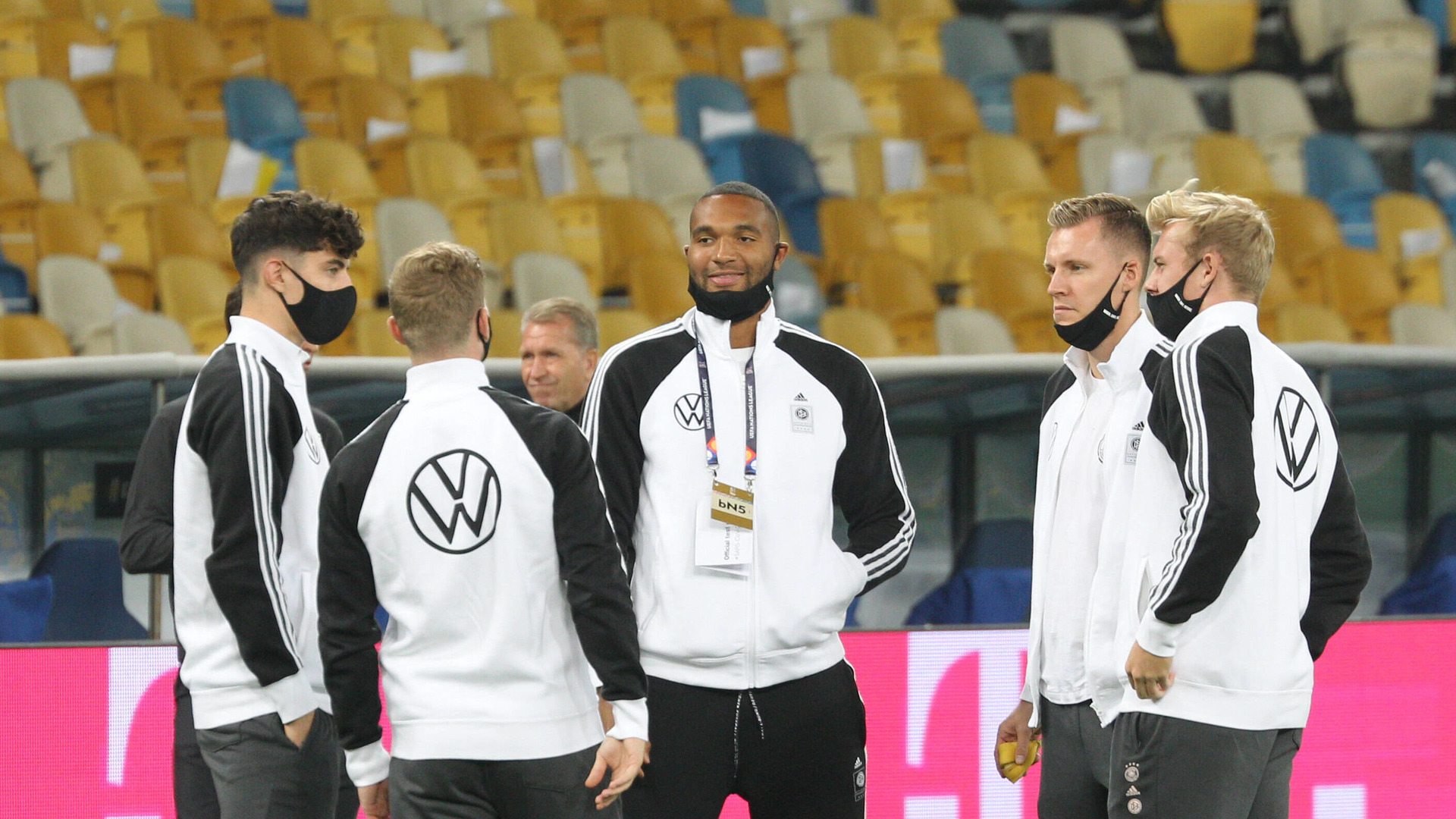
And do you feel more for Germany if Jonathan Tah, Nadiem Amiri or Kai Havertz and Julian Brandt are playing for Germany?
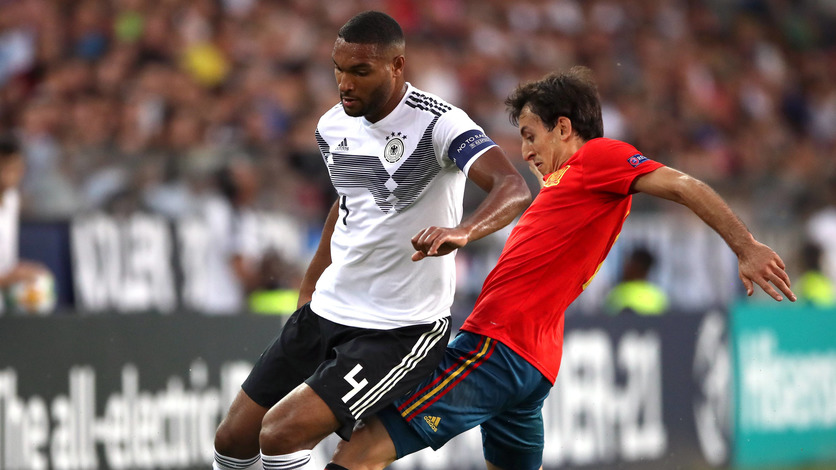
Definitely. I remember the U21 Euros in 2019. Jona was captain of the Germany team that played Spain in the final. Over the course of the game, I noticed I was changing sides and wanted the Germans to win more. But it wasn’t enough in the end.
Last question: Who’ll win the game?
I think Germany are capable of doing better at the moment. Even though they receive a lot of criticism from the German public, which is typical by the way, and I currently rate Jogi Löw’s team more. Either Germany will win or it will be a draw.

The United Nations International Day of Persons with Disabilities (IDPD) is celebrated worldwide on 3 December. Together with Bayer AG, Bayer 04 is once again setting an example for diversity and inclusion by lighting up the BayArena in purple in the evening.
Show more
Two first goals, two victories and a total of eight players in action: During the international break in the Google Pixel Women's Bundesliga, the Werkself were represented on the international stage, particularly in two Germany junior teams. Bayer04.de provides an overview of the international fixtures.
Show more
The Werkself have reached the quarter-finals of the DFB Pokal for the third time in a row. Thanks to a goal from Ibrahim Maza and, according to coach Kasper Hjulmand, a strong defensive performance, Bayer 04 once again defeated a Bundesliga rival in the DFB Pokal tie in Dortmund. The Werkself review of the 1-0 win at Signal Iduna Park.
Show more
A thriller with a successful outcome! The Werkself won the round of 16 clash at Borussia Dortmund by a goal to nil thanks to a 34th-minute strike from Ibrahim Maza. It means they'll be in the DFB Pokal come the spring!
Show more