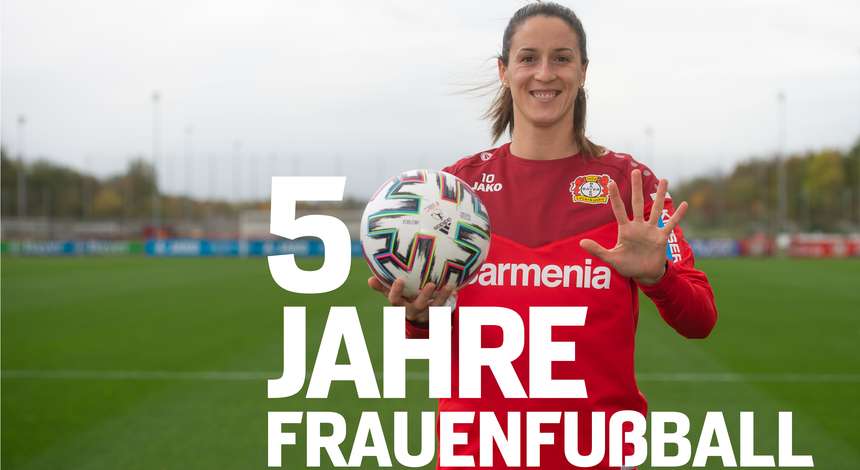
“Women’s football is a great sport and has been an important part of our club for many years. The women players are role models for countless girls and women. In my eyes, it’s incredible how late this was recognised in Germany. But to be honest: We still have a lot to do to further establish women’s football,” said Thomas Eichin, head of youth and women’s football at Bayer 04.
And Jessica Wich, captain of the Bayer 04 women, also sees further potential for development: “Of course, I’m very happy that women’s football has made this positive development. Unfortunately, I think the status and appreciation in our society is still too limited in my opinion. I hope there’ll be more interest in and attention paid to our sport in the future.”
Back to the history of women’s football: 15 years before the change in the constitution, the DFB called for a “ban on ladies football.” In the period after the Second World War, the DFB forbade its members from founding women’s team or even letting women play on club grounds. The justification back then sounds ridiculous today: “Feminine grace disappears in competing for the ball. Body and soul suffer unavoidable damage and display of the body impinges on decorum and decency.”
The change came in 1970 under certain provisions – including a ban on boots with studs, lighter balls, shorter halves of 30 minutes each and the regulation for a long winter break. The first women’s champions of Germany won their title in 1974 – the first official international only came at the end of 1982.
From SSG 09 Bergisch Gladbach to Bayer 04
Over the course of time, the Women’s Bundesliga has developed into one of the leading women’s leagues worldwide. Bayer 04 joined on 1 July 2008 having taken over the women’s football section at TuS Köln. The roots go even further back: At the very start of the new Bayer 04 football department there was SSG 09 Bergisch Gladbach. The women’s team attracted attention across Germany, above all in the 1970s and 1980s, when they dominated women’s football in Germany – they were champions of Germany nine times between 1977 and 1989 and also won the DFB Cup three times. In 1990, Bergisch Gladbach were one of the founding members of the Women’s Bundesliga. However, it was all downhill for the club in the following years. They were not only relegated from the top-flight in 1994 but the whole section moved over to TuS Köln rrh. 1874.
Another relegation from the then second-tier Regional League West in 1999 was followed by immediate promotion and in 2002 qualification for the newly introduced second division that was not taken up for organisational reasons but a season later they rose to the second division as champions. In spite of success on the pitch, Tus Köln rrh. were unable to find a sponsor in 2008 to help with the desired promotion to the Bundesliga. At the same time, Bayer 04 expressed an interest in starting a women’s football department – so the two things came together: In June 2008, the women’s section at TuS Köln rrh. was dissolved and moved completely under the Bayer Cross on 1 July. The first team were in the top flight from 2010 to 2017 and again from 2018/19.
#50JahreFF
Bayer 04 are supporting the 50-year anniversary of women’s football in Germany with the digital campaign of the DFB aimed at bringing together clubs, players, fans and the wider public to make a joint stand for women in football. Fans and other supporters of clubs can join in with the campaign on social media channels using the hashtag #50JahreFF.