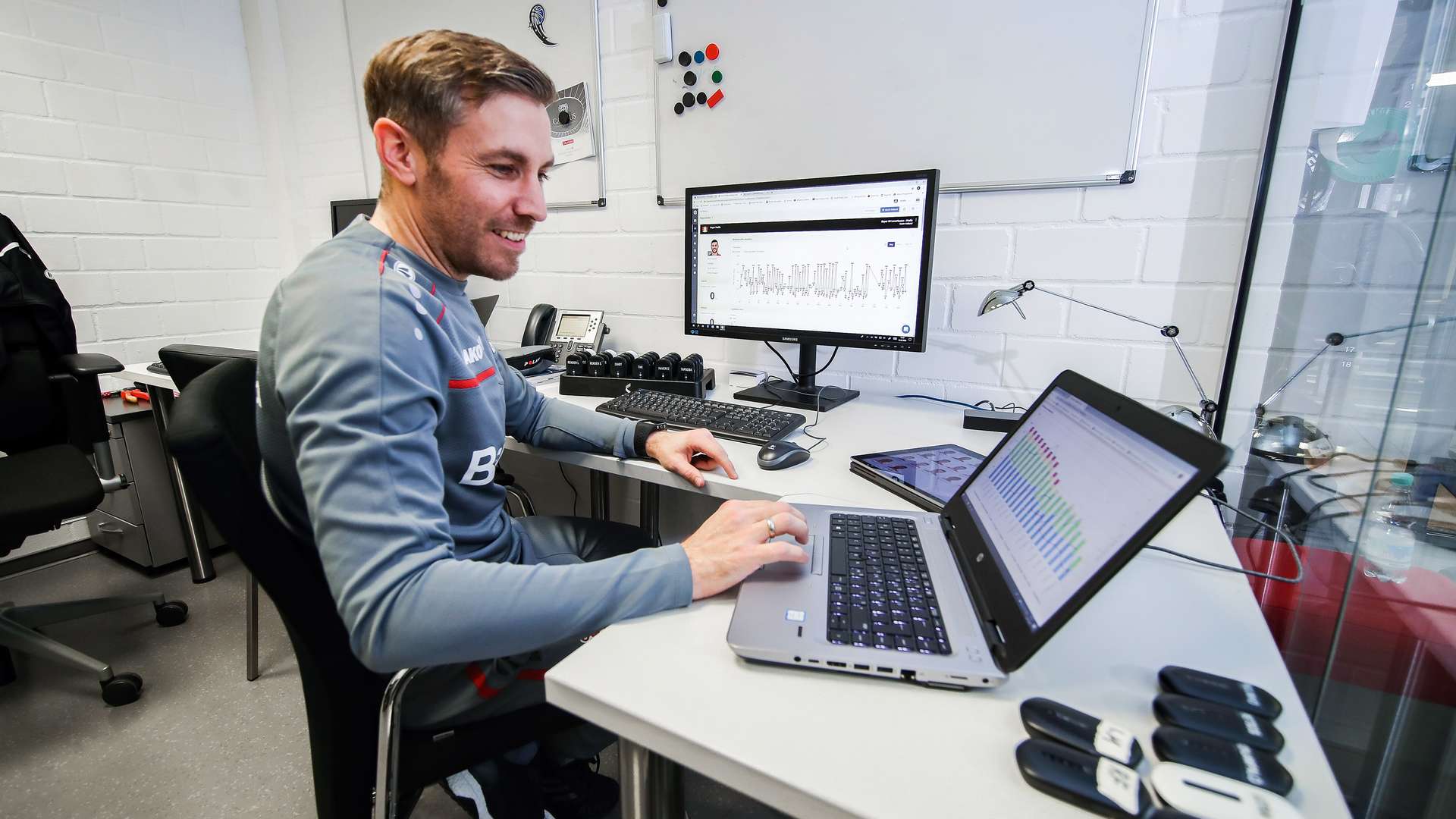
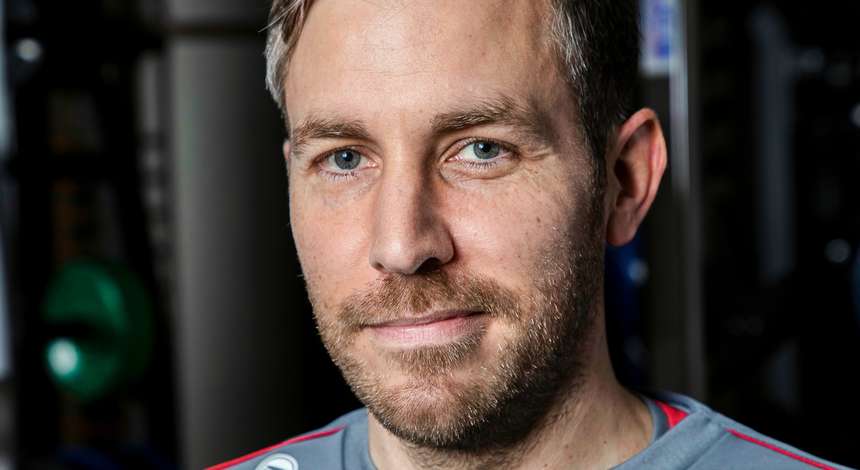
How fit are the players when they start training? Who's had a knock? How good is regeneration after peak performances? How do you ensure that psyched up players do not go to sleep full of adrenaline after a night match? Dr Malte Krüger has the answer to all these questions. The 37-year-old from Wuppertal is the head sports scientists at the Werkself in the medical section led by Dr Karl-Heinrich Dittmar.
But why do you need a qualified sports scientist if the medical section at Bayer 04 has doctors, physiotherapists, masseurs and psychologists who look after each individual player? That's down to the training philosophy of Peter Bosz. Krüger: "Coach Bosz likes it to be short and snappy." And that means for Krüger and his team keeping a constant eye on the physical stress on the players and providing feedback to the coaching staff.
When Peter Bosz only worked hard, yet focused, with the players in the morning at the preseason training camp in the summer of 2019 in Zell am See, many members of the media ask themselves: So little training? A wellness holiday in Salzburger Land? On the other hand, the BILD Zeitung headline read: "Just one training session per day: Coach Bosz explains his power plan." Yes, Peter Bosz prefers to only have one training session per day but a proper one. The players were pushed to their performance limits. "100 per cent once is better than 50 or even 60 per cent twice," according to the Bosz philosophy.
The sessions are so tough that a second training session can seriously increase the risk of injury. Bosz' training strategy, which is also used by top European clubs like Barcelona and Chelsea, not only increases stamina but also creates leeway. That gives the team more time for match tactics, video analysis and set situations – and for regeneration. And that's particularly important so that the players can be fully fit again for the next match day. But how is Bosz supposed to know when the players have reached their performance limits in training?
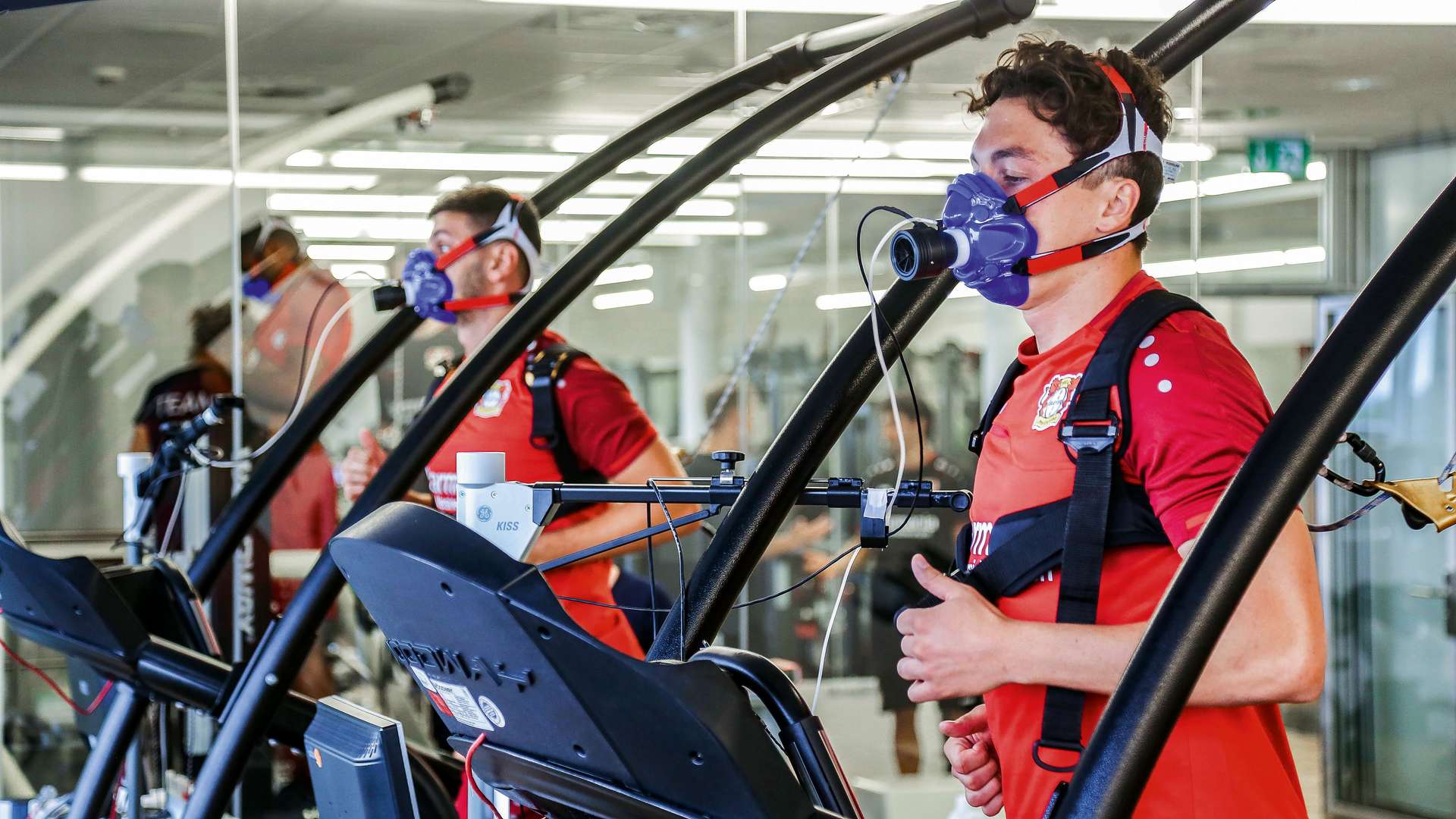
That's where Dr Malte Krüger comes in. At the start of the season, every player goes through three hours of tests on their hearts and kidneys. That produces a blood count that is much 'more comprehensive' than with every normal athletes. Players go on the treadmill wearing breathing masks to enable analysis of the composition of their expelled air. That reveals how the body processes oxygen, and breaks down carbohydrates and fat. Also mineral values such as vitamin D content are important. "If the vitamin D content is too low then there's a danger of muscle injuries," said Krüger . The body, muscle structure and motion sequences are also investigated. Plus stamina and fitness. Markers in the blood show the condition of a player. The glass football player.
But the performance tests at the start of the season and after the winter break are just the beginning. At every training session, Krüger collects individual performance data for each player. A GPS transmitter, attached to the players’s backs, transfers performance parameters to his laptop. “How many kilometres does a player run, how many sprints and jumps does he make, how quickly does a player accelerate and slow down, plus turns and speed: We record that in real time and we can even inform the coaching staff during the drills about which players have too low and too high workloads as the latter could lead to injuries,” said Krüger.
The introduction of workload limits should increase stamina and strength and improve the fitness profile. “The higher workload tolerance, the above-threshold stimulation should ensure that players have more air and as much strength and energy after 70 minutes to help them avoid making mistakes. That increases the possibility of success on the pitch,” said Krüger in explaining the value of workload control. The fact we were talking about high-performance sport became clear at the latest when Krüger talks about squad players. “They also train during the week to be fully match-fit. If they are not used then the main workload is missing on Saturday. We have to, at least partially, catch up with the high workload of a match.” The target: The squad players should have the same rhythm of workload and regeneration.
And where can you learn about workload monitoring, how to assess players so accurately and control their individual training needs quickly? At the German Sport University in Cologne of course. Krüger studied there and did his Ph.D. at the Institute for Training Science and Computer Science in Sport and he first came into contact with Bayer 04 players in 2009. The Werkself have had a partnership with the Sport University for many years and benefited from the latest insights of the scientists. Dr. Krüger became head of the university partnership with Bayer and he joined Bayer 04 Leverkusen at the start of 2019.

And what does a typical day’s work look like for the sports scientist? Krüger arrives at the stadium at least two hours before training starts, checks the current performance and workload data for each player and discusses them with the club doctors, physiotherapists and coaching staff. That makes it possible to set individual training workloads for each player. During the training sessions, Krüger observes the players and evaluates the training data. That allows the coaching staff to adjust workloads as required.
And now back to the initial question: What can players do if they are pumped full of adrenalin after a game and they can’t get to sleep? “They can go into the cold chamber. Our South American players don’t like it. But that makes it possible to reduce stress hormones quicker and that helps with relaxation. And sleep is the best aid for regeneration.” Good to know.
Axel Mörer

Bayer 04 host Bayern Munich in the semi-finals of the 2025/26 DFB Pokal. The tie will be played on Wednesday, 22 April 2026, at the BayArena with the kick-off at 20:45 CEST. Information on ticket sales.
Show more
Bayer 04 have the chance to reach the quarter-finals of the UEFA Champions League for the third time ever and the first in 14 years at Arsenal on Tuesday night (kick-off 21:00 CEST/20:00 local time). To do that, the Werkself not only require a strong performance like in the first leg, but also full concentration until the very last minute, as the Premier League leaders like to score late - as they did at the BayArena last week. Here's the Matchday News.
Show more
A special award for special social commitment. At this year's ceremony for the Sepp Herberger Awards in Wolfsburg on Monday night, the DFB Sepp Herberger Foundation recognised Bayer 04 in the social rehabilitation category. The Bundesliga club received the prize, together with €12,000, for its great service to inmates, particularly in the Wuppertal-Ronsdorf prison.
Show more
Can Bayer 04 pull off a coup in London? Just over a week after the 1-1 draw in the first leg of the 2025/26 UEFA Champions League round of 16 tie, the Werkself are now looking to put in a convincing performance away at Arsenal – and get a result to secure a place in the quarter-finals. Ahead of the match on Tuesday, (kick-off: 21:00 CET), head coach Kasper Hjulmand shared his thoughts on the team’s hunger for success. Exequiel Palacios, meanwhile, spoke about the importance of the fixture and the team’s development over the past few months.
Show more
In their last two matches, they’ve done exactly what 'Laterkusen' did in the 2023/24 double-winning season: late on, but not too late, the Gunners scored crucial goals – first in the first leg of the UEFA Champions League round of 16 at Bayer 04, then last weekend in the Premier League against Everton. This Tuesday, 17 March (kick-off: 21:00 CET), Arsenal host the Werkself in London. The latest on our opponents.
Show more